
The cost of impunity for slain Tamil journalists in Sri Lanka
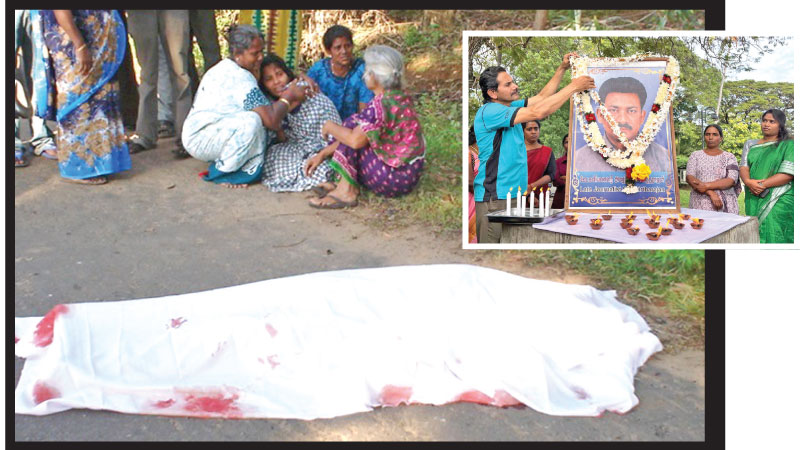
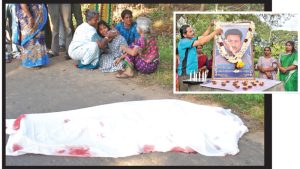
On the morning of January 24, 2006, Subramaniyam Sugirdharajan was waiting for the bus near the Governor’s Secretariat in Trincomalee. It was around 6.00 a.m. Two men on a motorcycle fired at him from close range. Sugirdharajan died on the spot. The attackers escaped, despite the area being under heavy military and police presence.
Sugirdharajan, widely known as SSR, was 35 years old. He was a Sri Lankan Tamil journalist, a social activist, and the father of two young children. He worked as a part-time provincial correspondent for the Colombo-based Tamil daily Sudaroli and the Jaffna-based Uthayan. His reporting focused on human rights abuses, civilian killings, and the conduct of State and paramilitary actors during the civil war.
In early January 2006, Sugirdharajan played a key role in exposing the killing of five Tamil students in Trincomalee, better known as the Trinco 5 Murder case. While the authorities said that the students had died when a grenade they were carrying exploded, Sugirdharajan obtained photographs from the Trincomalee mortuary. The images showed gunshot wounds to the heads of the students, contradicting the official version. The photographs were published and circulated widely, undermining the State narrative.
Just one day before his death, Sugirdharajan had written an article detailing human rights violations allegedly committed by pro-Government paramilitary groups.
Broader pattern
The Committee to Protect Journalists recorded Sugirdharajan’s killing as part of a broader pattern of attacks against Tamil-language media at the time. His newspaper had previously been targeted with grenade attacks. No suspects were arrested for his murder, and no one has been held accountable.
Nearly two decades later, the consequences of the killing continue to shape the lives of his family.
Chairman of the Batticaloa Press Club, Valasingham Krishnakumar, said the family was shattered in the aftermath of the assassination. Sugirdharajan’s mother fell ill and died shortly afterwards. His father also died not long after. His wife continued to pursue justice for years and died six months ago. Today, their two children are living in severe economic hardship.
Sugirdharajan had written with documentary evidence for Sudaroli on several incidents, including the Trinco 5 killings and acts of violence attributed to the Eelam People’s Democratic Party, Krishnakumar said. It was within this context that he was shot dead in Trincomalee. To this day, there has been no justice for his murder or for his family.
Describing the case as one of many, Krishnakumar said this was the situation faced by the family of Subramaniam Sugirdharajan, one of the 39 Tamil-speaking journalists who were murdered or disappeared in Sri Lanka.
He said successive Governments had spoken publicly about the rights of journalists who were killed or disappeared and had previously supported protests demanding justice. More than a year after the current Government took office, he said, the situation remained unchanged.
What is now being asked, Krishnakumar said, is for cases involving disappeared and murdered journalists to be re-examined through a mechanism under international supervision, and for justice to be delivered.
Convenor of the Jaffna Press Club, Rathnam Dayabaran, said the killing and abduction of Tamil journalists followed a sustained pattern over a decade. He said the culture of targeting journalists began with the assassination of BBC Tamil correspondent Mayilvaganam Nimalarajan in 2000 and continued until around 2010.
During that period, Dayabaran said, at least 39 Tamil journalists and media workers were killed or forcibly disappeared. Many of them were reporting from the North and the East at the height of the war. Some were abducted. Others were shot. Several disappeared without any trace.
He said that during the final stages of the war, journalists and media workers based in the Vanni region were killed or disappeared along with members of their families. According to him, there was no effective documentation or follow-up in many of those cases, and most remain unaccounted for.
Dayabaran said journalists who worked for media outlets affiliated with the Liberation Tigers of Tamil Eelam(LTTE) should also be recognised as journalists. He said the Jaffna Press Club considered them media workers who performed journalistic duties in return for a salary.
As an organisation, he said, the Jaffna Press Club had helped several families of journalists killed in the Jaffna region to relocate abroad for their safety. For families who remained in Jaffna, housing and basic support were arranged with assistance from the Tamil diaspora. He said no Government that came to power after the war had assisted these families.
Domestic mechanisms
The Jaffna Press Club, he said, continues to demand investigations and accountability for the killings of journalists. However, he said there was no confidence that justice would be delivered through domestic mechanisms alone. He said investigations could take place within Sri Lanka, but only under the supervision of international media organisations.
Dayabaran also referred to promises made during the Good Governance Government period to investigate attacks on journalists and to provide compensation of Rs. one million to affected journalists and their families. He said that, in practice, not even a single rupee was paid.
Many parents of killed and disappeared journalists have since died, he said, without ever receiving justice.
Dayabaran said the figure of 39 Tamil journalists includes those allegedly killed by State forces as well as those killed by the LTTE and various other groups.
According to him Tamil journalists continue to be marginalised in national commemorations held in the South.
Senior lecturer at the University of Jaffna, Dr. M. Thiruvarangan, said the prolonged protests by families of the disappeared in the North and the East illustrate the depth of unresolved grief. He said many mothers and family members who protested for years have since died without receiving answers.
He said the Government bears responsibility for responding to these communities. Mechanisms that were introduced, such as the Office on Missing Persons (OMP), failed to address the grievances of affected families adequately. He said the same failure applies to cases involving journalists.
According to Thiruvarangan, this is why families of the disappeared and sections of the Tamil community are increasingly turning to international avenues for justice. He said domestic processes have not inspired confidence or produced tangible outcomes.
He also said the issue of disappearances and killings attributed to the LTTE must be addressed. He referred to cases such as that of poet Selvi, who is believed to have died in LTTE detention. Although the LTTE no longer exists, he said there should still be mechanisms or spaces to examine what happened as part of the Tamil national liberation struggle, which also involved violence against dissenting activists and human rights workers.
January became synonymous with media suppression in Sri Lanka due to a clustering of attacks on journalists during the war and its immediate aftermath. Several high-profile killings and disappearances occurred during this month, including Lasantha Wikramathunga, Subramaniyam Sugitharajan and Prageeth Ekneligoda in different years, creating a pattern that journalists began to mark collectively.
Unanswered crime
Nearly twenty years after Subramaniyam Sugirdharajan was shot dead in Trincomalee, justice remains elusive. He documented evidence that contradicted an official narrative. He was killed in a high-security area. No one has been held accountable. His parents died without seeing justice. His wife pursued answers for years before her own death. His two children grew up in the long shadow of an unanswered crime.
Successive Governments have acknowledged the killings of journalists, announced mechanisms, and made assurances of accountability. Yet the outcomes have remained largely symbolic. With another change of political power, including under the current National People’s Power-led administration, the unresolved cases of murdered and disappeared journalists stand as a test rather than a legacy.
If the pattern continues, Black January will remain not only a month of remembrance but also a record of institutional failure. For families such as Sugirdharajan’s, the question is no longer how often justice is promised, but whether the State is willing to confront the impunity that has endured for decades.